Everything you need to know about rosacea: From blushing to effective laser treatment
Rosacea is an extremely common, chronic skin condition, and it is no coincidence that its name refers to a “rose-like” appearance: its main feature is a persistent, reddish change in the facial skin with dilated blood vessels.
Dr. Katalin Bodai3 min read

Rosacea is an extremely common, chronic skin condition, and it is no coincidence that its name refers to a “rose-like” appearance: its main feature is a persistent, reddish change in the facial skin with dilated blood vessels. Although genetic factors and individual predisposition play a huge part in its development, many people are unaware that they are suffering from a continuously progressing condition.
The first symptoms usually appear at a young age, in the form of intermittent facial redness and mild swelling. However, because the condition typically follows a fluctuating course – in other words, flare-ups are followed by symptom-free periods – most of those affected tend to play the problem down. Unfortunately, most patients only see a doctor at around the age of 40-50, at a much more advanced stage, even though the more severe changes could be effectively prevented with treatment started in time.
The three stages of rosacea: How does the skin's condition worsen?
Over the course of the disease, we distinguish three clearly separable phases:
- Rosacea erythaematosa, teleangiectatica (dilation of the blood vessels): In this initial stage, sudden episodes of redness (so-called “flushes”) appear on the central part of the face (mainly on the nose, forehead, cheeks and chin), accompanied by an unpleasant burning sensation like a hot flush. At first, the skin still fully returns to its original state between episodes. Over time, however, the repeated flushing leads to permanently dilated blood vessels (telangiectasias), which remain visible even between episodes.
- Rosacea papulopustulosa (inflammatory bumps): In the second stage, in addition to the redness, small pus-filled bumps resembling pimples appear on the skin, and these only clear up on their own over a very long time. The inflammatory flare-ups become longer and longer, and the bumps may spread across the entire face. Although the picture resembles teenage acne, an important difference is that there are no blackheads in rosacea, and the skin takes on a characteristic purplish-red tone because of the many dilated tiny vessels.
- Rhinophyma (overgrowth of connective tissue): The third and most severe stage is characterised by a build-up of connective tissue and an overgrowth of the sebaceous glands, developing on the back of repeated inflammation. Most often this leads to thickening and unevenness of the skin of the nose, which in everyday language is often simply called a “potato nose”.
A modern solution: Laser treatment for dilated blood vessels
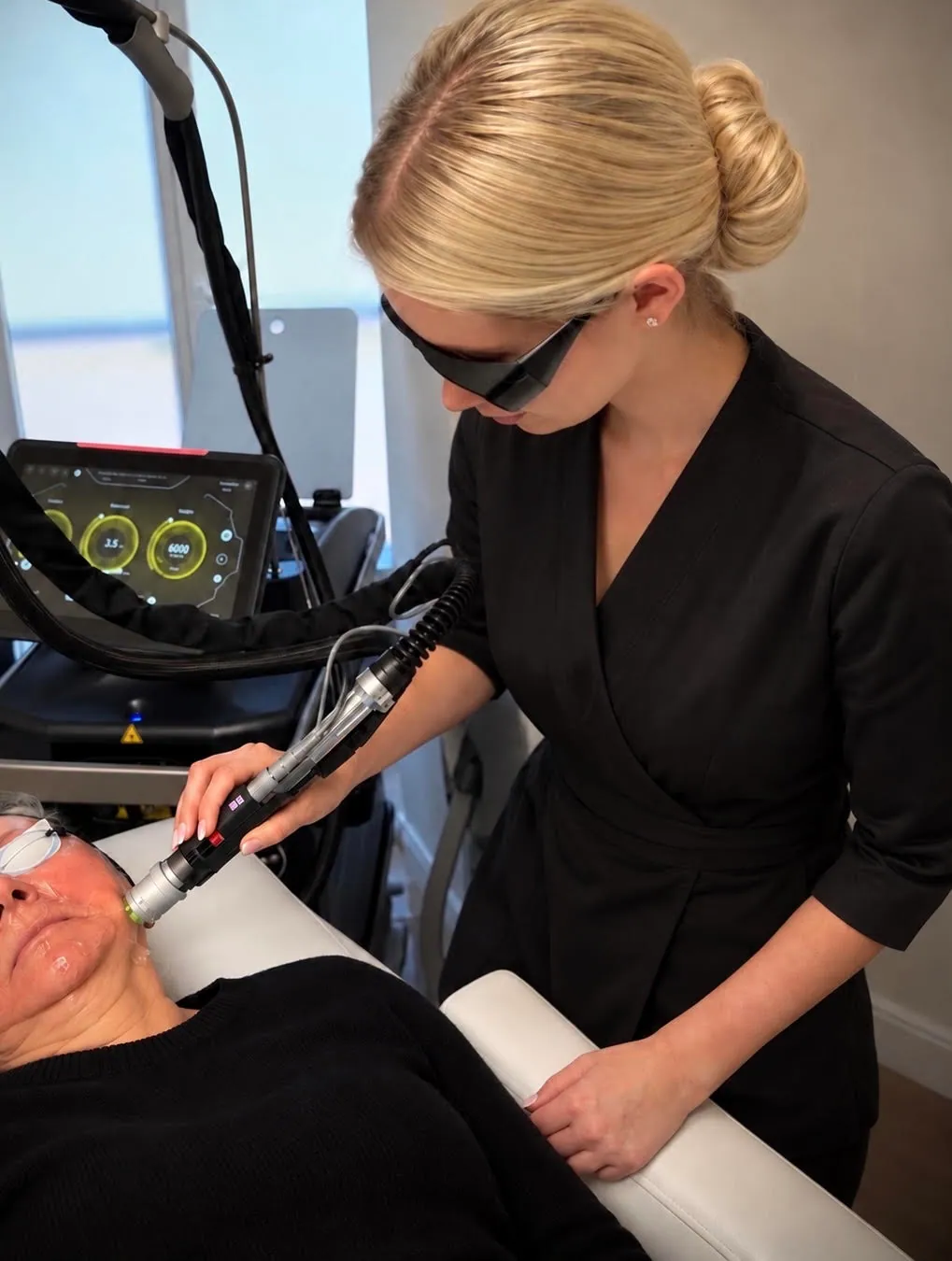
Rosacea is a chronic condition that gradually gets worse without treatment, but modern dermatology now puts an extremely effective weapon in our hands. The state-of-the-art lasers used at our clinic can specifically target and eliminate the dilated vessels that cause the problem.
The treatment is based on what is known as selective photothermolysis. During the process, the high-energy laser light is absorbed exclusively in the dilated vessels (by the haemoglobin), without damaging the surrounding healthy skin tissue. The heat released causes the walls of the dilated vessels to gently stick together, the vessel closes off and, over time, it is reabsorbed without a trace through the body's natural processes.
One of the greatest advantages of the laser procedure is that even a single treatment can produce a striking, visible improvement. If you would rather not wait until the condition progresses to the more severe stages involving inflammation or tissue overgrowth, it is worth seeing a specialist as soon as the first persistent tiny vessels appear. With laser therapy started in time, you can preserve the health of your facial skin and its even, attractive appearance in the long term.